

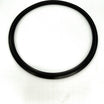
Tri-Clamp PTFE Envelope Gasket, Viton Core, 1 to 6 in.

ABOUT THIS PART
A tri-clamp gasket with a PTFE envelope over a Viton core, also sold as PTFE encapsulated Viton, in 1 to 6 in. The PTFE faces the process and the Viton core gives it spring-back, so it suits joints that are broken and remade every run. Torque it as a rigid gasket, 50 in-lb.
SPECIFICATIONS
| Construction | PTFE envelope, Viton (FKM) core |
|---|---|
| Compliance | FDA compliant |
| Sizes and prices | 1 in. $6.50, 1.5 in. $6.95, 2 in. $6.50, 4 in. $15.50, 6 in. $59.50 |
| Temperature | -100 F to 400 F, continuous static use (material rating) |
| Solvents | Butane, propane, ethanol, heptane, pentane, hexane, isopropyl |
| Torque | 50 in-lb, the rigid gasket figure |
| Replace | Every 3 to 6 months, or at once on cracking, tearing or set |
| Quantity per system | 22 six inch gaskets on a 20 LB system, 44 on a 40 LB |
| Ships | Stocked in Bend, Oregon. In-stock parts ship in 1 business day |
TECHNICAL DETAILS
PTFE envelope tri clamp gasket with a Viton core, FDA compliant, in 1, 1.5, 2, 4 and 6 inch, from $6.50.
Also sold as PTFE encapsulated Viton.
PTFE chemistry with spring-back. The envelope gives the chemical resistance, including isopropyl. The Viton core gives it the recovery solid PTFE does not have, so the joint reseals instead of taking a set.
Sizes and price
| Size | Price |
|---|---|
| 1 in | $6.50 |
| 1.5 in | $6.95 |
| 2 in | $6.50 |
| 4 in | $15.50 |
| 6 in | $59.50 |
These are standing prices, not a promotion. The 6 inch is the size a 20 LB system runs 22 of.
The numbers
- Temperature: -100 F to 400 F (-73 C to 204 C), continuous static use
- Clamp torque: 50 in-lb, the rigid figure. An elastomeric gasket takes 30
- Compliance: FDA compliant
- Excellent on: butane, propane, ethanol, heptane, pentane, hexane and isopropyl
Which material for which job
| Material | Temperature | Torque | Pick it when |
|---|---|---|---|
| PTFE envelope, Viton core | -100 F to 400 F (-73 C to 204 C) | 50 in-lb | Cold service, or a joint broken every run |
| Solid PTFE | -350 F to 500 F (-212 C to 260 C) | 50 in-lb | Cold service on a joint that stays made up. Cheaper |
| Viton (FKM) | -40 F to 400 F (-40 C to 204 C) | 30 in-lb | The hydrocarbon default, including isopropyl |
| Buna-N | -30 F to 250 F (-34 C to 121 C) | 30 in-lb | Water, food, general sanitary. Cheapest |
| Silicone | -85 F to 450 F (-65 C to 232 C) | 30 in-lb | Steam and food. Severe on every hydrocarbon |
The main case that sends you here is anything running colder than Viton's -40 F (-40 C) limit.
The cold end, and what actually limits it
Minimum solvent temperature on an N.B. Oler system is -40 F (-40 C) on standard elastomeric gaskets. On the cold end of a run the gasket is the limiting component, not the vessel, so check the gasket against your lowest process temperature rather than against the vessel rating.
Where this one sits
- PTFE against the process and a Viton core behind it, rated -100 F to 400 F (-73 C to 204 C) as a material.
- Viton remains the default on a hydrocarbon system and it is what we run in our own shop, rated -40 F to 400 F (-40 C to 204 C). Note that -40 F and -40 C are the same temperature, which is why both units read -40.
- In our own operating experience Viton gives the best results in cold service of the elastomers we have used. That is shop experience rather than a laboratory result. This envelope gasket is the step up from it, for the coldest work.
Replacement and quantities
- Replace every 3 to 6 months regardless of how it looks
- Replace immediately on any cracking, tearing, splitting or permanent deformation
- A gasket that has taken a compression set passes a cold leak check and then weeps once the line comes up to pressure. That is why interval beats inspection on a gasket
- A 20 LB system takes 22 six inch gaskets. A 40 LB takes 44
- Full comparison: Choosing the right gasket material for tri-clamp connections
Stocked in Bend, Oregon. In-stock parts ship in 1 business day.
| FITS | Tri-clamp joints on 10, 20 and 40 LB systems. Also sold as PTFE encapsulated Viton. It is the one to use where temperatures below Viton's -40 F (-40 C) rating rule out Viton, and particularly on joints that get broken and remade every run. Sizes are 1, 1.5, 2, 4 and 6 inch. Torque to 50 in-lb, the rigid figure, not the 30 in-lb an elastomeric gasket takes. For a joint that stays made up, a solid PTFE gasket costs less and does the same job chemically. |
|---|
▦ IN YOUR MANUAL
This part appears in the operator manual that ships with your system. The QR code there links to this page.
◈ REFERENCE FOR THIS PART
COMMON QUESTIONS
What is the Viton core for?
The PTFE envelope gives the chemical resistance. The Viton core inside gives it spring-back, so the joint reseals instead of taking a set. That is the difference between this and a solid PTFE gasket.
Is this the same as PTFE encapsulated Viton?
Yes, the same part. PTFE envelope, Viton filler, PTFE encapsulated Viton, all the same gasket.
Envelope or solid PTFE?
Solid PTFE is cheaper and right for a joint that stays made up. The envelope is for a joint broken every run, because it recovers instead of taking a set.
Why is the torque different from Viton and Buna-N?
This is a rigid gasket, so it takes 50 in-lb against 30 for an elastomeric one. Torquing a rigid gasket to elastomeric spec will leak, and torquing an elastomeric gasket to rigid spec destroys it.