

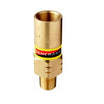
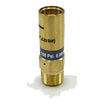
Generant Cryogenic Relief Valve, Brass, 1/4 in. MNPT, 10 to 350 psi
OFTEN BOUGHT TOGETHER
ABOUT THIS PART
A Generant brass cryogenic relief valve, 1/4 in. MNPT, factory set and locked at one of nine pressures from 10 to 350 psi. It is rated to -320 F at 50 psi and up (PCTFE seal). Below 50 psi the seal is Fluorosilicone and the rating is -85 F. It is not ASME coded.
SPECIFICATIONS
| Connection | 1/4 in MNPT, male, port code 250B |
|---|---|
| Set pressures | 10, 22, 50, 100, 150, 200, 250, 300, 350 psi (0.7 to 24.1 bar) |
| Adjustable | No. Factory preset, permanently locked and stamped |
| Body and spring | Brass, ASTM B16. 302 stainless or 17-4PH spring |
| Seal | Fluorosilicone 10 to 49 psi. PCTFE 50 psi (3.4 bar) and above |
| Temperature | -85 F to 350 F (-65 C to 176 C) below 50 psi. -320 F to 165 F (-196 C to 74 C) at 50 psi and above |
| Orifice | 0.250 in (6.35 mm), same as the 1/2 in valve |
| Flow | 117 SCFM at 250 psi (17.2 bar) set, per 3P Certz ECR-250902-R0 |
| Cleaning and testing | Cleaned for oxygen service, 100 percent factory tested |
| ASME code stamp | No. See the Generant RVA |
DOCUMENTS
TECHNICAL DETAILS
Generant brass cryogenic relief valve, 1/4 in MNPT male, factory set and permanently locked. Nine set pressures from 10 to 350 psi (0.7 to 24.1 bar). $84.00, with three pressures on clearance from $39.00.
These are the relief valves fitted to N.B. Oler hydrocarbon systems and the ones we resupply to the people running them.
The short version
- Connection: 1/4 in MNPT male, port code 250B
- Orifice: 0.250 in (6.35 mm). The 1/2 in valve uses the same orifice and does not flow more
- Flow: 117 SCFM at a 250 psi (17.2 bar) setting, per 3P Certz engineering report ECR-250902-R0
- Full rated flow at 110 percent of set pressure. Back pressure to 10 percent has no effect on the setting
- Brass body, 302 stainless or 17-4PH spring, seal changes with set pressure
- Set pressure is factory locked and stamped on the valve. It is not adjustable
- Not ASME coded. If an inspector wants a stamp, see the Generant RVA in 1/2 in
- Cleaned and packaged for oxygen service, 100 percent factory tested, screened Dirt Guard poppet
Set pressures and price
| Set pressure | Price |
|---|---|
| 10 psi (0.7 bar) | $84.00 |
| 22 psi (1.5 bar) | $42.00, clearance |
| 50 psi (3.4 bar) | $84.00 |
| 100 psi (6.9 bar) | $84.00 |
| 150 psi (10.3 bar) | $42.00, clearance |
| 200 psi (13.8 bar) | $39.00, clearance |
| 250 psi (17.2 bar) | $84.00 |
| 300 psi (20.7 bar) | $84.00 |
| 350 psi (24.1 bar) | $84.00 |
The 22, 150 and 200 psi are being cleared from stock below our normal price. Same valve, same factory setting, same warranty. When they are gone the price returns to $84.00.
Pick the pressure for the location. Do not buy one and try to turn it.
How cold it goes depends on the set pressure
| Set pressure | Seal | Temperature range |
|---|---|---|
| 10 to 49 psi (0.7 to 3.4 bar) | Fluorosilicone | -85 F to 350 F (-65 C to 176 C) |
| 50 psi (3.4 bar) and above | PCTFE | -320 F to 165 F (-196 C to 74 C) |
So the 10 psi and the 22 psi are not -320 F (-196 C) valves, and the 50 psi and up do not reach 350 F (176 C). For genuinely cryogenic service order 50 psi or higher.
Which pressure goes where
| Location on a 20 LB system | Set pressure |
|---|---|
| Solvent vessel | 250 psi (17.2 bar) |
| Solvent vessel jacket | 100 psi (6.9 bar) |
| Chiller line and jacket inlets | 22 psi (1.5 bar) |
| Material column | 250 psi (17.2 bar) |
| Material column jacket | 100 psi (6.9 bar) |
| Color remediation column | 250 psi (17.2 bar) |
| Recovery vessel | 250 psi (17.2 bar) |
| Molecular sieve | 250 psi (17.2 bar) |
| CO2 supply | 350 psi (24.1 bar) |
| Manifold | Varies by build |
From 3P Certz Certificate of Conformance 3PC0930. Your build sheet governs.
When to replace, and what to keep on the shelf
| What the valve does | Replace at |
|---|---|
| Pops off constantly | 3 months |
| Just sees cold and discolors | 6 months |
| Neither of those | 12 months |
Discoloration means cold cycling, and a valve you have heard vent this month is a three month valve.
Spares, from our operators manual: 22 psi three plus one, 100 psi one plus one, 200 psi one plus one, 250 psi six plus one, 350 psi two plus one.
Before you order
- Match the number stamped on the valve you are replacing
- Below 50 psi (3.4 bar) you are buying a -85 F (-65 C) valve, not a -320 F (-196 C) valve
- Need an ASME stamp? Order the Generant RVA instead
- More detail: Cryogenic relief valve selection
Usually on the shelf and ships from Bend, Oregon. When a set pressure is out, figure one to two weeks.
| FITS | Fits any 1/4 in FNPT port on a hydrocarbon or cryogenic system. Set pressure is factory locked and not adjustable, so order the pressure for the location: 250 psi (17.2 bar) on solvent vessels, material columns, the CRC, the recovery vessel and the molecular sieve; 100 psi (6.9 bar) on vessel jackets; 22 psi (1.5 bar) on the chiller line and jacket inlets; 350 psi (24.1 bar) on CO2 supply. Manifold ratings vary by build. Below 50 psi (3.4 bar) the seal is Fluorosilicone and the rating is -85 F (-65 C), not -320 F (-196 C). This valve is NOT ASME code stamped; the 1/2 in Generant RVA is. The 1/2 in CRV is a separate page and uses the same 0.250 in orifice. |
|---|
▦ IN YOUR MANUAL
This part appears in the operator manual that ships with your system. The QR code there links to this page.
◈ REFERENCE FOR THIS PART
COMMON QUESTIONS
How do I know which set pressure I need?
Match the number stamped on the valve already on your system. If the stamp is unreadable, the fitment table on this page gives the standard pressure for each location on a 20 LB system, and your build sheet governs.
Is the 10 psi valve rated to -320 F (-196 C)?
No. At 10 to 49 psi the seal is Fluorosilicone and the rating is -85 F to 350 F (-65 C to 176 C). At 50 psi and above the seal is PCTFE and the rating is -320 F to 165 F (-196 C to 74 C).
Does the 1/2 inch relief valve flow more than the 1/4 inch?
No. Both use a 0.250 inch (6.35 mm) orifice, so relieving capacity is the same. Choose by the port on your vessel.
How often should a relief valve be replaced?
A valve that pops off constantly, every 3 months. A valve that sees cold and discolors, about 6 months. A valve that rarely lifts, 12 months.